Venturi VTRA · Ref. VTRA375

VTRA 375 adjustable Venturi pneumatic conveyor (−84.4 kPa)

High-vacuum conveying vacuum pump with ring-adjustable flow: draws in and conveys powders, granules and small parts using compressed air alone.

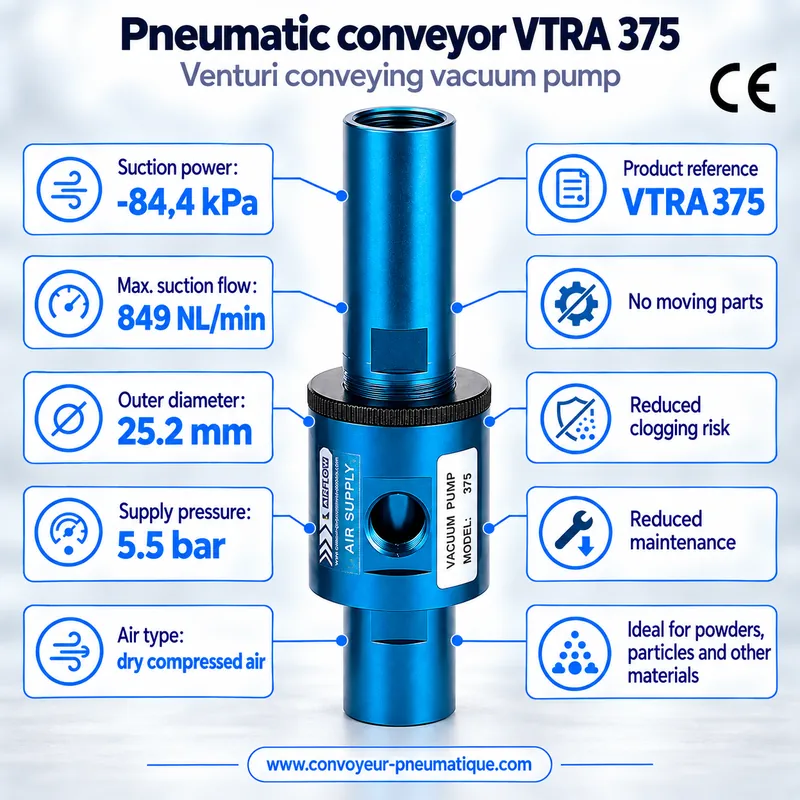
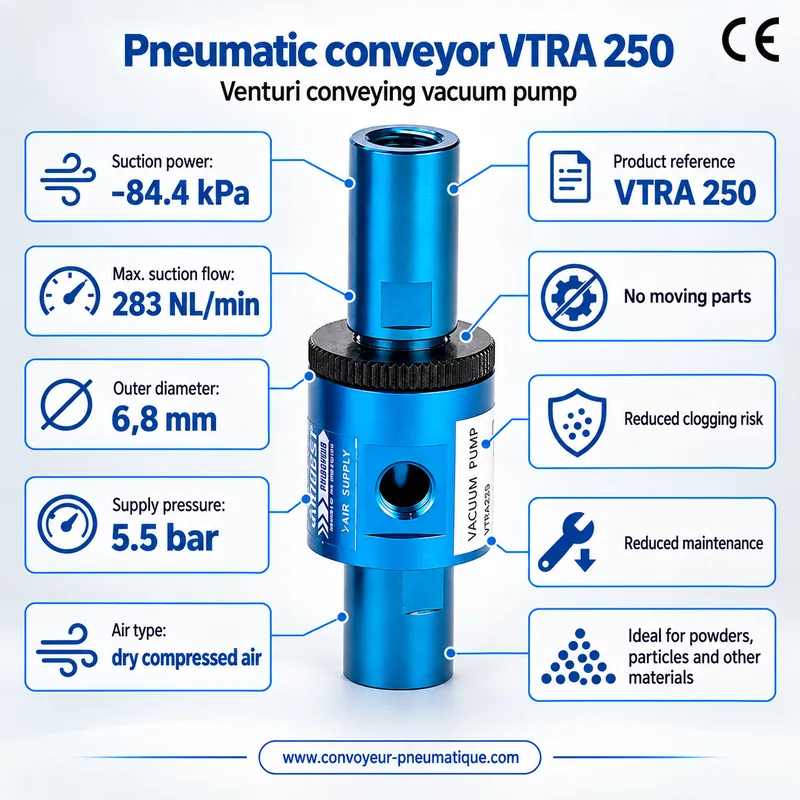
  • Max. vacuum−84.4 kPa
  • Max. suction flow849 NL/min
  • Inner bore (ØA)Ø 9.6 mm
Material
€250.00 excl. VAT i.e. €300.00 incl. VAT (FR VAT 20%)
Request a quote
  • Made to order: shipped within 1 to 2 weeks
  • Tracked shipping to France, Europe and worldwide
  • 100% secure payment: card, Apple Pay, Google Pay, SEPA
  • Free technical advice to choose the right model
VTRA range datasheet PDF document · dimensions and performance

Video

The Venturi pneumatic conveyor in action

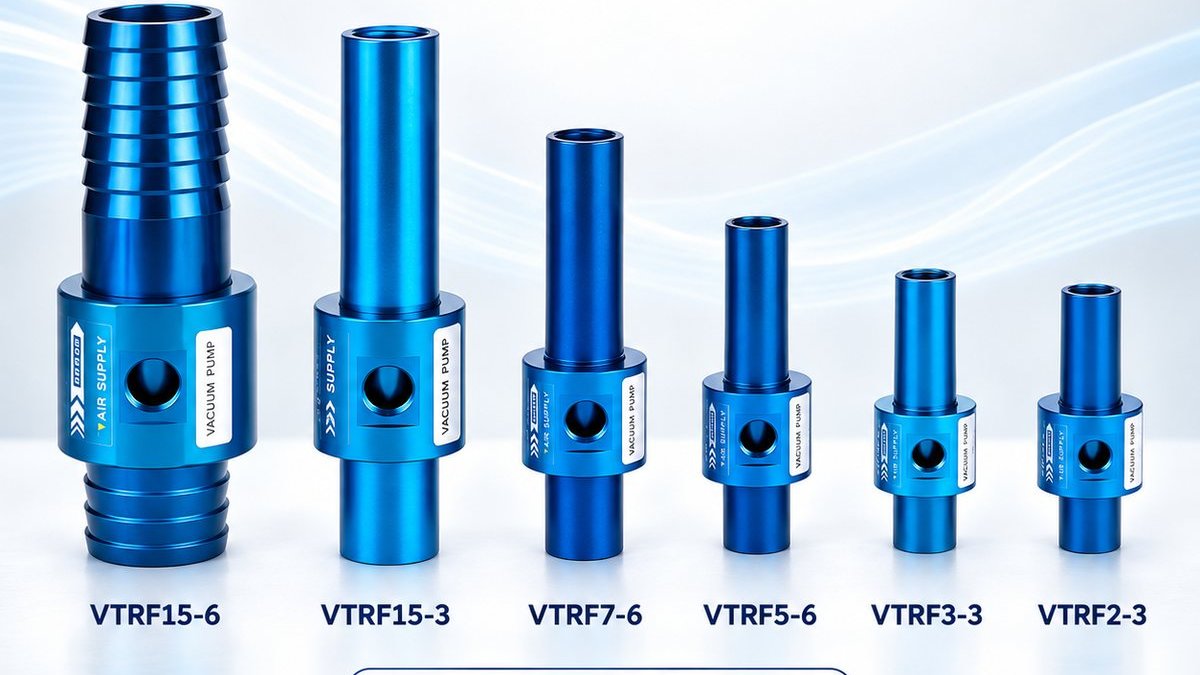
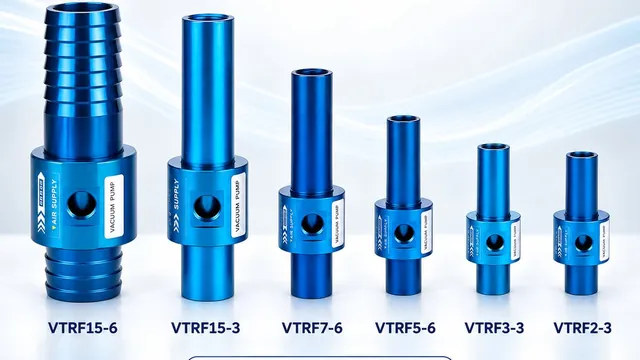
VTRF Venturi pneumatic conveyor in operation
VTRF Venturi pneumatic conveyor in operation Demonstration of a VTRF Venturi pneumatic conveyor: suction and conveying of material with compressed air, no moving parts. Watch on YouTube · MP4

VTRA 375 Venturi pneumatic conveyor: description

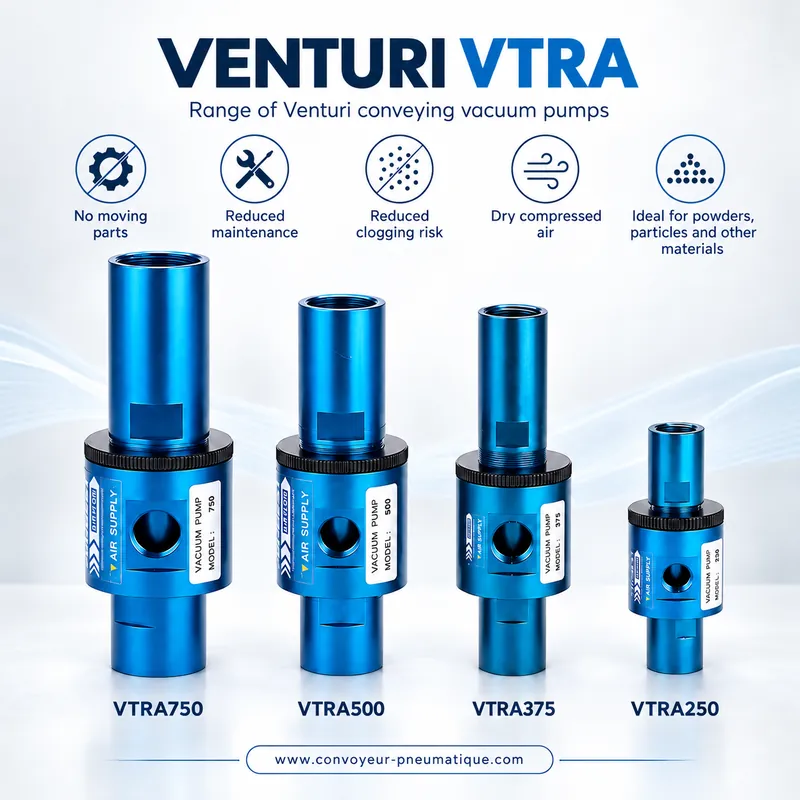
The VTRA 375 Venturi pneumatic conveyor reaches a vacuum of −84.4 kPa and draws up to 849 NL/min (at −16.9 kPa). Its Ø 9.6 mm inner bore and Ø 25.2 mm outer diameter make it suitable for dense materials and long distances.

It offers three times the flow of the VTRA 250 while keeping a strong vacuum: ideal for hopper loading.

Compressed air, connected to port G1, is accelerated through an annular nozzle: it creates strong vacuum at the suction port (G2) and propels the material to the outlet (G3). The rotating ring changes the air gap and lets you adjust suction flow by hand, without tools.

The body is made of light, corrosion-resistant anodised aluminium. All ports are female threaded (parallel G thread) for direct mounting on your pipework.

Key features of the VTRA range

  • High vacuum down to −84.4 kPa for dense materials
  • Flow adjustable by hand with the rotating ring
  • Straight-through bore: continuous, clog-free conveying
  • Female threaded ports (G1/8 to G1) for easy installation
  • No moving parts, no special maintenance
  • Anodised aluminium body, light and corrosion-resistant

Detailed technical specifications of the VTRA 375

Dimensions, performance and weight of the VTRA range: the row framed in red is the VTRA 375.

Dimensioned drawing of the VTRA Venturi conveyor Suction (G2) Outlet (G3) Compressed air (G1) Adjusting ring FEDT ØAØBØC
Schematic drawing — letters refer to the dimensions table below.

Dimensions (mm) and connections

Model ØAmm ØBmm ØCmm Dmm Emm Fmm Tmm G1 G2 G3
VTRA 250 6.8 18.8 31.3 41 31.6 22 3.7 G1/8 G1/4 G1/4
VTRA 375 9.6 25.2 43.5 69.8 44.4 37.6 5 G3/8 G1/2 G1/2
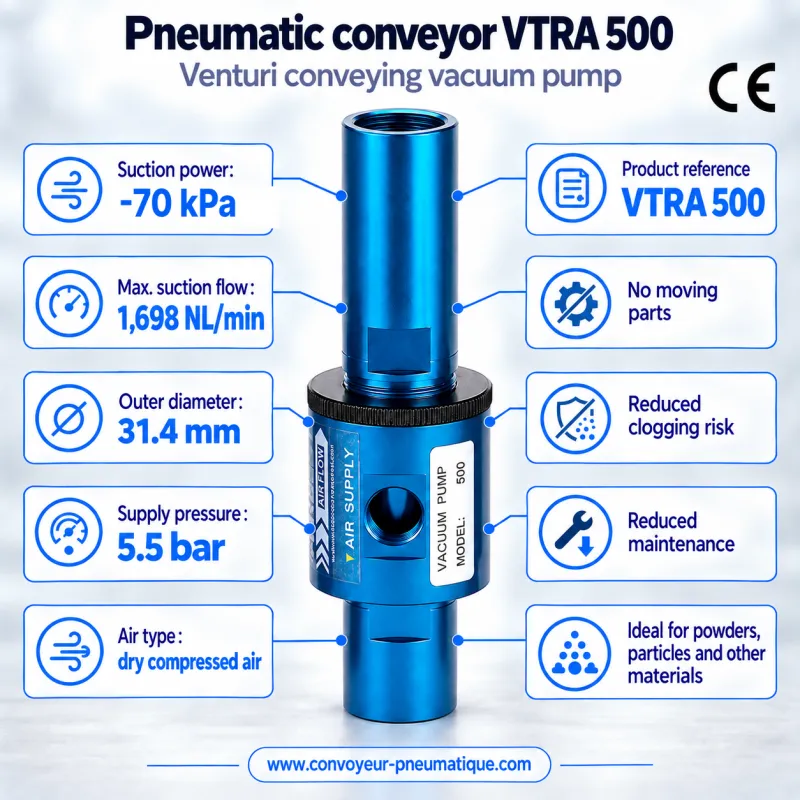
VTRA 500 12.7 31.4 50 63.5 50.8 38 5 G3/8 G1/2 G3/4
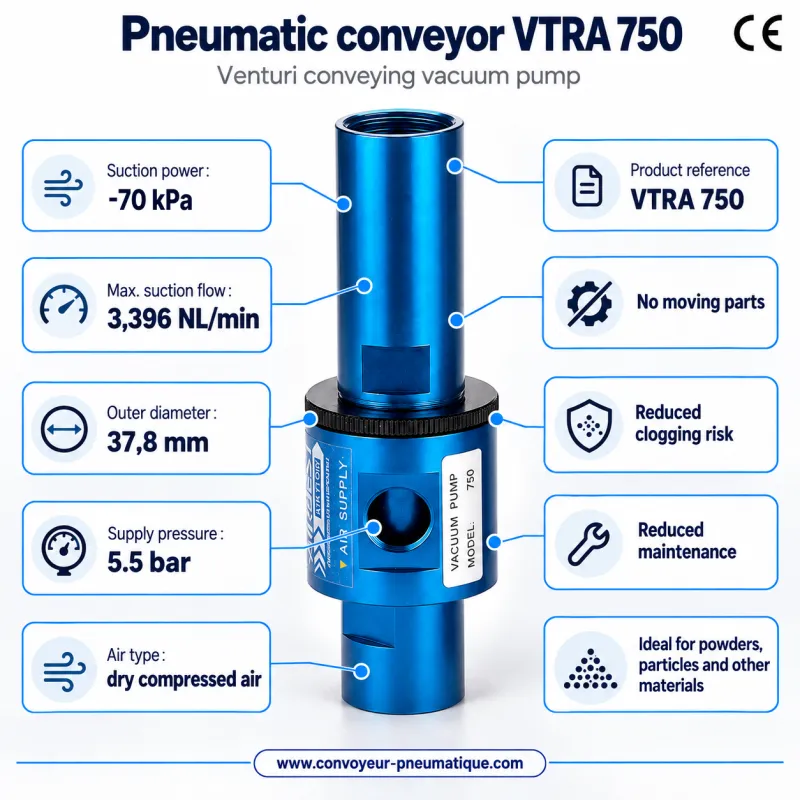
VTRA 750 19.1 37.8 56.8 85.7 50.8 38.2 5 G1/2 G3/4 G1

Air consumption (NL/min) by vacuum level, at 5.5 bar

Model −16.9 kPaNL/min −33.8 kPaNL/min −50.7 kPaNL/min −67.5 kPaNL/min −84.4 kPaNL/min
VTRA 250 113 170 235 275 340
VTRA 375 175 325 481 594 820
VTRA 500 340 623 792 934 1,274
VTRA 750 651 872 1,245 1,783 2,547

Suction flow (NL/min) by vacuum level

Model −16.9 kPaNL/min −33.8 kPaNL/min −50.7 kPaNL/min −67.5 kPaNL/min −84.4 kPaNL/min
VTRA 250 283 243 204 164 127
VTRA 375 849 736 623 524 396
VTRA 500 1,698 1,330 1,132 991 651
VTRA 750 3,396 2,462 1,975 1,443 1,132

Weight by material (g)

Model Aluminiumg
VTRA 250 100
VTRA 375 286
VTRA 500 401
VTRA 750 540

Typical applications

  • Unloading vibratory feeders and hoppers
  • Reloading hoppers with plastic regrind
  • Transferring engine valves and small parts during grinding
  • Removal of drilling chips
  • Transfer of powder detergent and caustic chemicals
  • Conveying peanut husks and light materials
  • Edge trim removal and mandrel collection

Need advice?

To recommend the ideal model, please prepare the following information:

  • The type of material to convey
  • The size of the items in mm (L × W × H)
  • The material density
  • The volume to convey (litres per second)
  • Abrasive or not, flammable or not
  • Dry conveying or in a wet/aquatic environment
  • The conveying distance and height (m)
  • Your installation: tubes and compressed air already in place?
Request a quote

How it works

How does a Venturi pneumatic conveyor work?

A Venturi conveyor turns compressed air into powerful suction, with no motor and no moving parts. Simply connect it to your air supply and to a conveying hose.

  1. 1
    Compressed air injection

    Air enters through the side port and fills an annular chamber around the central bore.

  2. 2
    Venturi effect

    Air is accelerated through nozzles pointing towards the outlet, creating strong vacuum at the inlet.

  3. 3
    Material suction

    Powders, granules, chips or small parts are drawn in through the inlet hose.

  4. 4
    Conveying and discharge

    The air stream carries the material to the discharge point, with no risk of clogging.

Diagram of the Venturi effect in a pneumatic conveyor 1 Compressed air 2 Venturi effect 3 Suction 4 Discharge

A pneumatic conveying project?

Describe your material and installation: free advice within 24 hours.